
Close

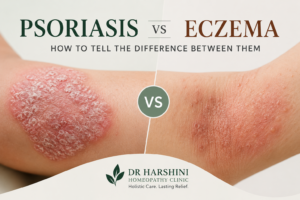 If you have persistent dry, itchy, irritated or scaly skin, you may wonder whether you are dealing with eczema or psoriasis. The two conditions can look surprisingly similar, especially during a flare-up, but they are different skin conditions and may require different approaches to management.
Understanding the differences between psoriasis and eczema can help you recognise possible warning signs and know when it is worth seeking professional advice.
At Dr Harshini Homeopathy Clinic in Singapore, we regularly focus on chronic and recurring health concerns, including skin conditions such as eczema and psoriasis. This guide explains the key differences between the two conditions and why an accurate assessment matters.
Both psoriasis and eczema can cause dry, inflamed and itchy skin. However, they differ in their underlying mechanisms, typical appearance, common locations and pattern of flare-ups.
Psoriasis is a chronic inflammatory condition associated with an overactive immune response that causes skin cells to build up rapidly. This can result in raised, well-defined patches covered with scales. Plaque psoriasis is the most common form of psoriasis.
Eczema, particularly atopic dermatitis, is associated with inflammation and disruption of the skin barrier. It commonly causes intense itching, dryness, irritation and recurring flare-ups.
Although there are typical patterns, psoriasis and eczema can sometimes overlap, making an accurate diagnosis important.
One of the most recognisable features of psoriasis is a thickened, raised and clearly defined patch of skin.
Common signs can include:
Psoriasis commonly affects areas such as the elbows, knees, scalp and lower back, although it can occur elsewhere on the body.
On darker skin tones, psoriasis may appear differently from the classic red-and-silvery appearance often shown in medical photographs. Colour can range from darker brown or purple tones to greyish areas, and the scaling may be more prominent.
Eczema is often associated with intense itching. In many people, the urge to scratch can actually become one of the most disruptive parts of the condition.
Depending on the type and severity, eczema may cause:
Atopic eczema can occur on different parts of the body. The areas affected can also vary according to age.
Unlike psoriasis, where plaques are often sharply defined and thickened, eczema can have a more variable appearance and may be associated with significant itching.
| Feature | Psoriasis | Eczema |
|---|---|---|
| Typical appearance | Raised, well-defined patches with scaling | Dry, inflamed, irritated or thickened skin |
| Scaling | Often thick and prominent | Usually finer or variable |
| Itching | Can be itchy | Often intensely itchy |
| Common locations | Elbows, knees, scalp and lower back | Commonly folds of the elbows and knees, hands and other areas |
| Skin texture | Often thick and raised | Often dry, rough or cracked |
| Nails | Nail changes can occur | Nail involvement is less characteristic |
| Joints | Psoriatic arthritis may occur | Joint symptoms are not a defining feature |
| Age of onset | Can occur at any age | Often begins in childhood but can develop at any age |
These are general patterns rather than rules. A skin condition does not always follow the textbook appearance, and some people may have features of both conditions.
Itching can occur with both conditions, but eczema is often particularly associated with intense itching.
With atopic dermatitis, itching can appear early and repeated scratching can make the skin more irritated, thickened and damaged.
Psoriasis can also itch and may cause burning, soreness or a tight sensation, particularly when plaques become extensive or irritated.
Therefore, itching alone cannot determine whether you have psoriasis or eczema.
Sometimes, yes.
This is one reason why searching for pictures online and attempting to diagnose yourself can be misleading. Skin conditions can vary according to:
The American Academy of Dermatology notes that psoriasis and eczema can overlap and that distinguishing between them is not always straightforward.
If a rash is persistent, repeatedly returns or is getting worse despite basic skin care, professional assessment can help determine what may be causing it.
Yes. Having symptoms that resemble both conditions does not necessarily mean that one diagnosis is incorrect.
There can be overlap between psoriasis and eczema, and some individuals may experience more than one inflammatory skin condition.
This is another reason why treatment should be based on an individual assessment rather than simply treating a rash according to an online photograph.
Singapore’s warm, humid environment can make skin symptoms particularly noticeable for some people. Sweat, environmental exposure, frequent bathing, irritants and individual sensitivities may influence how the skin feels during a flare-up.
Eczema is also a significant dermatological concern in Singapore. The National Skin Centre has reported eczema as its leading disease among new cases, highlighting how common the condition is locally.
If you live in Singapore and experience recurring itching, scaling, redness, thickened skin or unexplained rashes, keeping track of potential triggers and seeking appropriate professional guidance can be useful.
Consider getting your skin assessed if:
Persistent or recurrent symptoms deserve more than repeated trial-and-error treatment.
Diagnosis usually starts with a detailed assessment of the skin and a review of the patient’s symptoms, medical history and pattern of flare-ups.
For suspected psoriasis, clinicians may also look at the scalp and nails and ask about joint symptoms or family history. In uncertain cases, a skin biopsy may sometimes be considered.
Because eczema and psoriasis can resemble other skin conditions, it is important not to assume that every itchy or scaly rash is automatically eczema or psoriasis.
Both psoriasis and eczema can be chronic or recurrent, which means that managing symptoms often involves understanding the individual pattern of the condition rather than focusing only on a single flare-up.
Useful areas to discuss with a healthcare professional can include:
The objective is to understand the overall pattern and develop an appropriate, individualised approach.
So, what is the difference between psoriasis and eczema?
Psoriasis often presents as well-defined, raised and scaly patches, commonly affecting areas such as the elbows, knees and scalp. Eczema is more commonly associated with dry, inflamed and intensely itchy skin, although its appearance can vary considerably.
However, there is no single symptom that can reliably distinguish the two in every person. The conditions can overlap, and other skin disorders can look similar.
If you have persistent or recurring skin symptoms in Singapore, consider seeking professional advice rather than relying solely on online images or self-diagnosis.
At Dr Harshini Homeopathy Clinic, Singapore, consultations focus on understanding the individual’s symptoms, history and recurring health concerns.
If you are experiencing persistent eczema, psoriasis, skin irritation or recurring flare-ups, you can arrange a consultation to discuss your concerns and explore an individualised approach to care.
Dr Harshini Homeopathy Clinic
Singapore
This article is intended for general educational purposes and is not a substitute for professional medical diagnosis or emergency care. If you have a rapidly spreading rash, severe pain, significant swelling, signs of infection or other concerning symptoms, seek appropriate medical attention promptly.