
Primary headaches
A primary headache occurs as a condition in itself rather than as a symptom of another underlying disease.
Common examples include:
- Migraine
- Tension-type headache
- Cluster headache
- New daily persistent headache
Secondary headaches
A secondary headache occurs because of another condition or factor.
Possible causes can include:
- Infections
- Sinus-related conditions
- Head or neck injury
- Medication overuse
- Eye problems
- Certain vascular conditions
- Other underlying medical conditions
What Are the Symptoms of a Headache?
Headache symptoms depend on the specific type of headache and, of course, the person experiencing it. Some headache symptoms are: -Dull pain in the head -Pulsing pain in the head -Sensation of pressure in the head -Pain in the head, temples, neck, or shoulders -Pain behind the eyes -Pain in the back of the head or neck -Sensitivity to light, noise, and smells -Nausea and vomiting -Disturbances in vision -Dizziness -Tiredness Not every person with a headache will experience all of these symptoms, but some will feel multiple. From a clinical perspective, the pattern, frequency, duration, and associated symptoms will help when assessing the headache.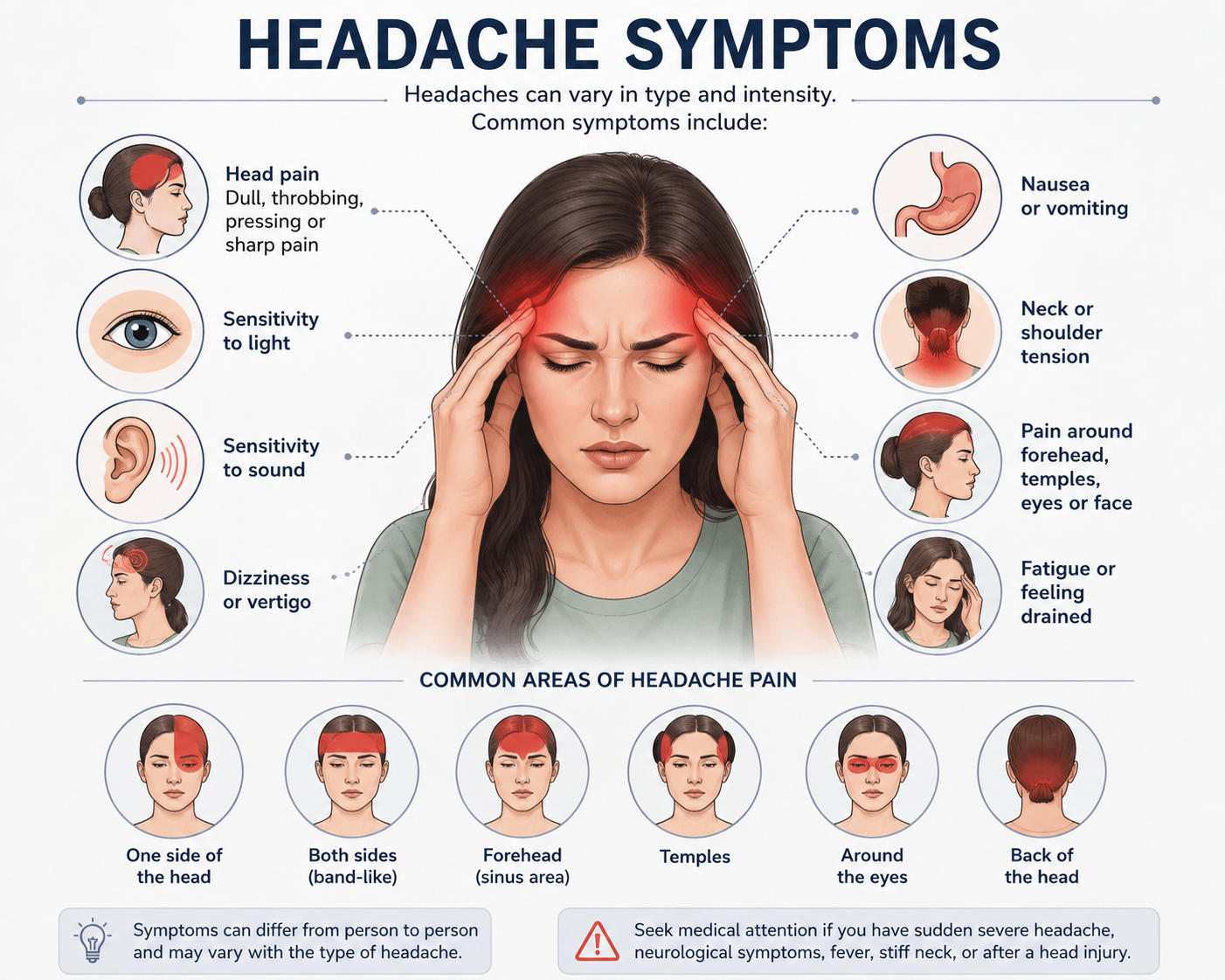
What Are the Different Types of Headaches?
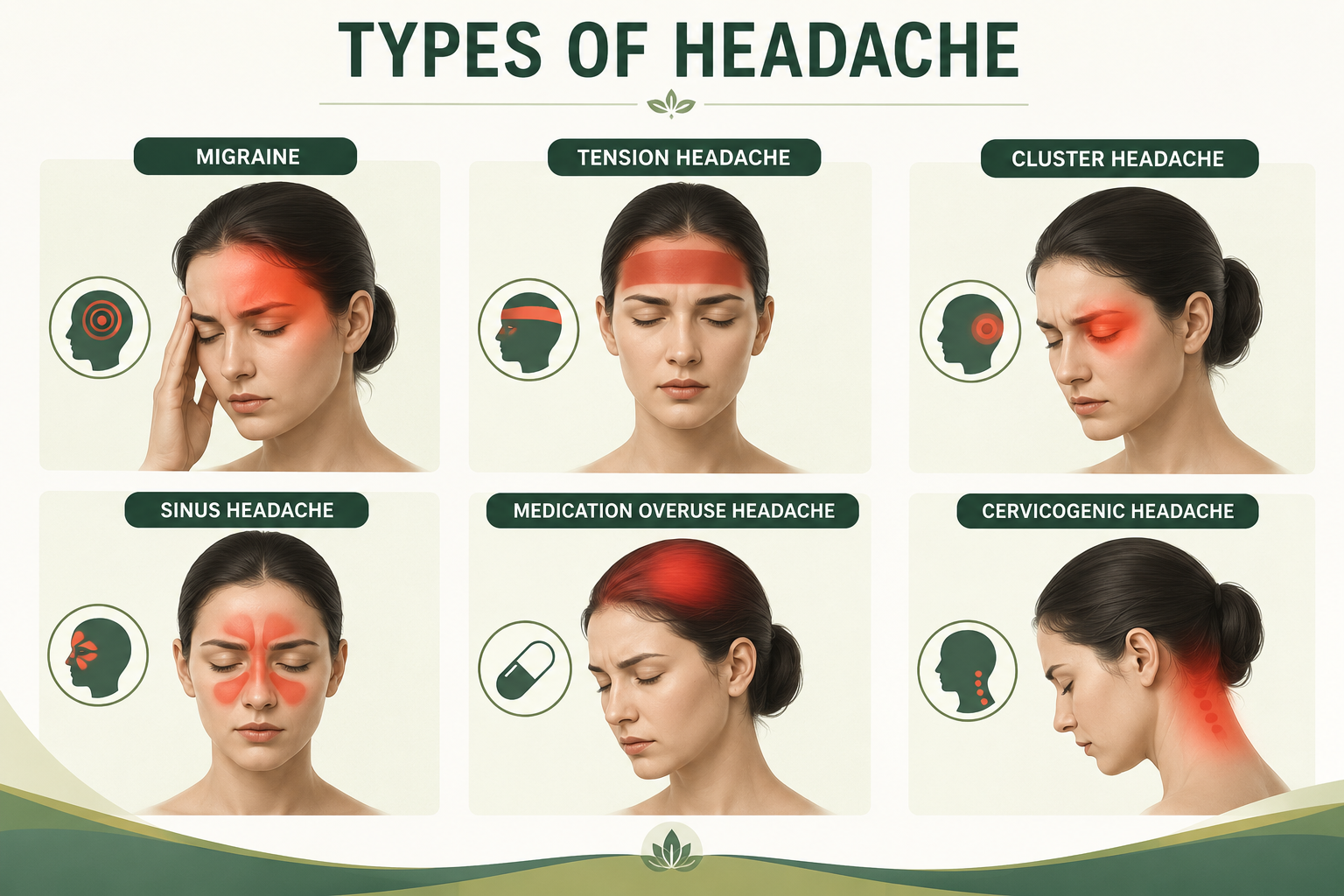
There are various headaches where some are more common and other types, while less common, can have severe complaints.1. Migraine- Migraine Alternate Treatment
For some persons, a migraine will have more severe pain than a normal headache, and the following pain can occur: -On one side of the head -Back of the head or front of the head -Severity of the pain is usually throbbing or pulsing Migraines can also occur with: -Nausea -Vomiting -Sensitivity to light and sound -Sensitivity to smells -Increased symptoms with physical activity -Visual disturbances -Some persons will also experience an aura Migraine pain can last for several hours and even days. The migraine headache is a common and disabling migraine headache and can affect a high percentage of Population of Singapore, based on local Singaporean headache guidelines.2. Tension-Type Headache
Tension headaches are the most common headaches. People often describe the pain as: -Pain concentrated around the head that is tight and aching -Pressure that is dull and heavy -A band like feeling around the head Some people feel pain in both sides of their head that is concentrated and aching and is often accompanied by tightness in the neck, shoulders and scalp. Stress and fatigue contribute to some forms of tension type headaches. Poor posture, eye strain, and prolonged screen use may contribute to some forms of tension type headaches. HealthHub also identifies stress, uneven sleep, poor posture and eye strain as potentially contributing to tension type headaches.3. Cluster Headache- Headache Treatment
Although less common, they can be very severe. The pain can be: -Intense -Sharp -Concentrated behind or around one eye -Often occurring on one side of the head -Can be accompanied by symptoms: -A red, watery eye -Facial sweating -Droopy eyelid -Restless They can occur several times throughout the day. Because there are many possible causes of one-sided severe headaches, you should evaluate unusual symptoms that are very severe.4. Sinus-Related Headache – Sinus Treatment
-Pain concentrated in your forehead, nose or eyes can be caused by sinus congestion. -Some accompanying signs and symptoms are: -Nasal congestion -Facial pressure -Postnasal drip -Decreased or loss of smell -Fever from some infections Not all headaches over the face or the forehead region can be attributed to sinus disease. Migraines can also manifest with some facial or nasal symptoms. Hence the overall picture is important.5. Medicine Overuse Headache
Using headache medications too often can disrupt the normal cycle of headaches. A person may notice: -Headaches occur. -Headache medications are taken. -Headaches occur again. -Headache medications are taken again. -Frequent headache recurrence. Medicine overuse headache can occur with the overuse of some headache medications. If you notice that you are using pain medication for headaches too frequently, you need to see a doctor instead of overusing pain medication. The guidelines for headaches in Singapore suggest that for patients who suffer from migraines too often, the use of acute medications is monitored.When Is a Headache Serious?
Most headaches are not caused by a serious condition. However, certain symptoms require prompt medical attention.
Seek urgent medical evaluation for a headache that is:
- Sudden and extremely severe
- The worst or an unusually severe headache you have experienced
- Associated with confusion
- Associated with weakness or numbness
- Associated with difficulty speaking
- Associated with significant visual changes
- Accompanied by seizures
- Accompanied by a stiff neck and fever
- Following a head injury
- New and significantly different from your usual headaches
- Becoming progressively worse
- Associated with loss of consciousness
Holistic Approach to Headache and Migraine Care
At Dr Harshini Homeopathy Clinic, the approach to recurring headaches is centred on understanding the individual rather than treating every headache as exactly the same.
A holistic consultation may explore the wider pattern surrounding the headache, including:
- Headache location
- Type and intensity of pain
- Frequency and duration
- Sleep
- Stress
- Daily routine
- Lifestyle
- Dietary patterns
- Hormonal influences
- Environmental triggers
- Associated symptoms
- Individual health history
This broader perspective can help build a more complete understanding of recurring headache patterns.
The aim is not simply to ask “Where does it hurt?”
It is also to ask:
“When does it happen?”
“What seems to trigger it?”
“What symptoms occur with it?”
“How does it affect your everyday life?”
“What pattern has developed over time?”
Homeopathy for Headaches and Migraine Treatment
Homeopathy is an individualised system of care in which remedies are selected according to the person’s overall symptom presentation.
At Dr Harshini Homeopathy Clinic, homeopathic care may be considered for individuals seeking a personalised and holistic approach to recurring headaches or migraine.
Rather than assuming that everyone with the same diagnosis experiences the condition in exactly the same way, an individualised consultation considers the person’s particular symptom pattern.
For example, two people may both describe their problem as “migraine”, but one may experience:
- One-sided throbbing pain
- Light sensitivity
- Nausea
- Headaches after poor sleep
while another may experience:
- Head pressure
- Neck tension
- Headaches during periods of stress
- Sensitivity to particular environmental factors
The overall pattern can therefore be important when developing an individualised homeopathic approach.
Homeopathy should be considered as complementary care and should not replace appropriate medical assessment, emergency treatment or prescribed care when these are needed.